Why PoA?
The Strategic Imperative for Proof of Authority in Enterprise Environments
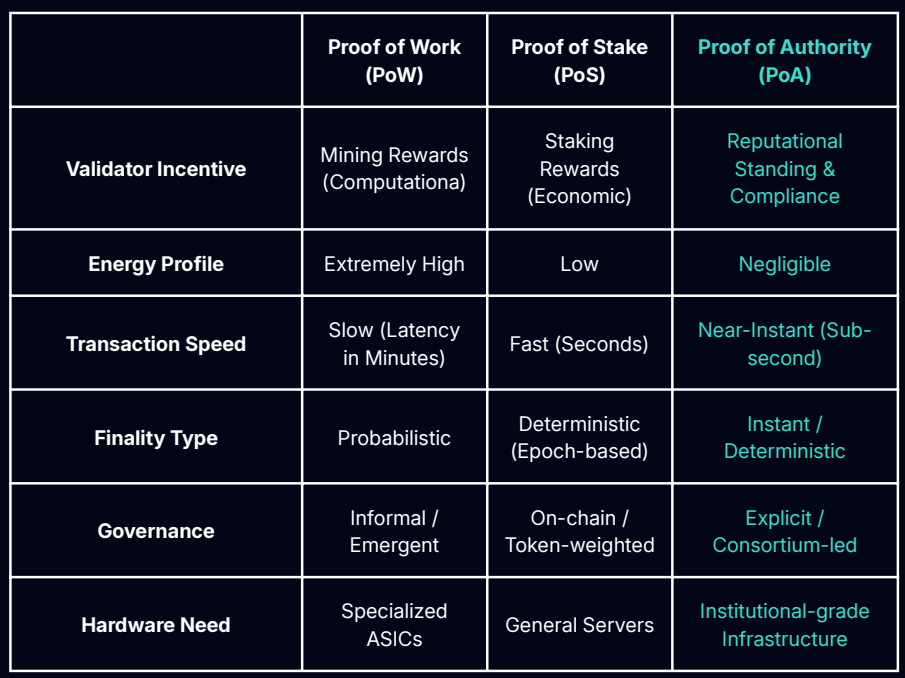
The selection of a consensus mechanism is the foundational decision that dictates a blockchain’s scalability, security profile, and operational governance. While Proof of Work (PoW) has established a decade of robust security for assets like Bitcoin, its reliance on massive energy consumption and probabilistic finality renders it unsuitable for the high-frequency, low-latency demands of enterprise settlement.
Proof of Stake (PoS), while significantly more energy-efficient and scalable, introduces its own complexities, including the risk of centralization among token-rich participants and a less proven security history compared to legacy systems. For the Ethstable network, Proof of Authority (PoA) emerges as the optimal solution, specifically engineered for permissioned and consortium deployments where participants are known and vetted entities.
PoA operates by placing trust in a limited number of pre-approved validator nodes whose identity and reputation serve as the collateral for the network’s integrity. Unlike PoS, where any participant with sufficient capital can theoretically influence the chain, PoA requires validators to undergo rigorous identity vetting and maintain a high standard of reputational standing. In an enterprise context, this model ensures clear accountability; if a validator acts maliciously, their real-world identity is exposed, leading to immediate legal and commercial repercussions.
This transparency solves a critical piece of the blockchain trilemma by trading extreme decentralization for superior scalability and speed, allowing Ethstable to process thousands of transactions per second (TPS) with near-instant deterministic finality.